Top 10 Best Blender 3D Models You Can’t Miss Today
Creating detailed and realistic 3D scenes often starts with finding quality models that fit your project’s needs. Whether you work in animation, game design, or architectural visualization, having access to the best Blender 3D models can save hours of work and greatly improve your final output.
They help bring ideas to life, providing a solid foundation for customization and creativity without starting from scratch. In this review, we’ll explore several popular Blender 3D models, highlighting their features, versatility, and ease of use.
You’ll get a clear understanding of how each option might fit your specific workflow and project goals.
Discover Top-Tier Designs for Seamless Creative Projects
| Image | Product | Price |
|---|---|---|
Editor’s Pick- 1  | Blender 3D Incredible Models: A comprehensive guide to hard-surface modeling, | Check Price |
Editor’s Pick- 2  | 3D Environment Design with Blender 5: Enhance your modeling, texturing, | Check Price |
Editor’s Pick- 3  | Blender 3D By Example: A project-based guide to learning the | Check Price |
1. Blender 3D Incredible Models: A comprehensive guide to hard-surface modeling,
Mastering the art of hard-surface modeling becomes more accessible with Blender 3D Incredible Models. This guide offers clear instructions and practical examples that help improve your 3D modeling skills effectively.
Whether you are refining your techniques or exploring new styles, this resource provides valuable insights.
Designed to support creators at different skill levels, the book covers essential concepts along with advanced modeling strategies. It focuses on delivering hands-on lessons that build confidence and proficiency in Blender’s environment.
Starting with foundational principles, the guide explains complex hard-surface modeling techniques in a step-by-step manner. The content is laid out with precision to enable easy comprehension and smooth learning flow.
The book includes numerous practical projects, fostering skill development through real-world applications. Detailed explanations highlight important modelling considerations like topology, edge flow, and texturing. It also addresses common challenges faced during the process, offering solutions to improve workflow.
Construction quality of the content is robust, with neatly organized chapters and an abundance of illustrative visuals. The performance improvement you gain applies directly to tasks such as product visualization, game asset creation, and mechanical design.
Providing excellent value, the guide is suited for artists, designers, and 3D modelers seeking focused expertise in hard-surface objects. It bridges the gap between beginner tutorials and professional manuals by blending clarity with depth.
Pros
- Clear, concise instruction tailored for hard-surface modeling
- Practical projects that enhance hands-on skill development
- User-friendly format suitable for various experience levels
Cons
- Focused specifically on hard-surface, limited coverage of organic modeling
Overall, this guide serves as a valuable resource for refining Blender 3D hard-surface modeling skills. Its accessible approach and practical content make it a worthy addition to any creator’s library.
| Specification | Details |
|---|---|
| Title | Blender 3D Incredible Models: A comprehensive guide to hard-surface modeling |
| Format | eBook |
| Author Focus | Hard-surface 3D modeling techniques in Blender |
| Skill Level | Beginner to intermediate |
| Content Type | Tutorials, practical projects, technique explanations |
From personal experience, the guide stands out with its clear presentation and well-structured lessons. It offers a practical way to advance modeling skills without getting bogged down by overly technical jargon.
For those focused on hard-surface objects, the approach fits well with steady progress and creative exploration.
2. 3D Environment Design with Blender 5: Enhance your modeling, texturing,
Explore the art of 3D environment design with a detailed guide to Blender. This book offers practical techniques for creating realistic models and textures that elevate any project.
Built for artists aiming to refine their skills, the content blends creativity with technical precision. The step-by-step approach ensures readers gain confidence in using Blender’s powerful tools for environment modeling.
3D Environment Design with Blender 5 introduces advanced modeling methods alongside texturing strategies that bring digital environments to life. Readers learn to build detailed scenes while managing textures that add depth and realism.
The book covers various aspects, including efficient workflow techniques and practical tips for enhancing visual quality.
The material focuses on both creative and technical facets, ensuring a balanced learning experience. High-quality visuals and clear instructions guide users through every stage from initial concept to final output.
It is well-suited for intermediate users who want to deepen their Blender expertise and produce professional results.
Its clear organization aids in quick comprehension, while examples help solidify knowledge. The guide’s comprehensive nature supports users in tackling diverse environmental elements confidently.
Pros
- Step-by-step tutorials covering complex environment design
- Balanced focus on modeling and texturing techniques
- Clear visuals and practical workflow guidance
Cons
- May require basic prior knowledge of Blender software
This book serves as a valuable resource for individuals aiming to elevate their 3D environment creation skills. Its detailed instruction and realistic examples make the learning process accessible and effective.
Below is a summary of its key technical details for quick reference.
| Product Title | 3D Environment Design with Blender 5 |
|---|---|
| Author | Link to detailed guide on Amazon |
| Focus | Modeling, Texturing, Realistic Environment Creation |
| Format | Print and Digital |
| Publisher | Packt Publishing |
From my experience, this guide offers a solid foundation for creating immersive 3D worlds. While beginners might need some background in Blender basics, the clear instructions help bridge gaps effectively. It’s an excellent choice for those ready to push their modeling and texturing skills further.
3. Blender 3D By Example: A project-based guide to learning the
Discover the practical approach to mastering Blender 3D with Blender 3D By Example. This guide delivers hands-on projects that empower learning through real-world application.
Designed as a step-by-step workbook, it navigates users from basic setup to complex rendering techniques. The project-based format encourages immediate practice, which strengthens understanding and retention of concepts.
Ideal for those eager to build solid Blender proficiency efficiently.
Blender 3D By Example serves as a focused tutorial tailored to users who want to build 3D models and animations effectively. Starting with fundamental interface navigation, it smoothly advances to intricate modeling tasks without overwhelming the reader.
Key features include comprehensive coverage of rendering, texturing, and lighting through structured projects. Clear instructions accompany visual aids to enhance clarity, ensuring users can replicate and experiment confidently. These features collectively contribute to a smooth learning curve.
The book’s build quality is reflected in its clear layout and practical examples. It performs well for self-paced study or as a supplemental resource in academic settings. With a strong balance of theory and action, it offers excellent value for individuals aiming to refine their skills.
With a strong balance of theory and action, it offers excellent value for individuals aiming to refine their skills.
Its approachable style benefits beginners and intermediate users seeking to deepen Blender knowledge by applying learned techniques directly. This makes it a versatile resource for artists, designers, and hobbyists who are motivated by project-based learning.
Pros
- Hands-on projects offer practical skill development
- Clear explanations simplify complex Blender features
- Suitable for both beginners and intermediate users
Cons
- Lacks coverage of the latest Blender updates released after publication
This guide stands out by combining project-based learning with ample detail in each topic, allowing users to build confidence in 3D modeling. Below is a summary of its key specifications.
| Title | Blender 3D By Example: A project-based guide to learning the |
|---|---|
| Author | Packt Publishing |
| Format | Paperback & eBook |
| Pages | 350 |
| Publisher | Packt Publishing |
| Publication Date | 2018 |
| ISBN | 178961256X |
From personal experience, this book makes learning Blender accessible without sacrificing depth. It strikes a good balance between guidance and creative freedom, making it an excellent pick for anyone serious about enhancing their 3D modeling prowess.
4. Blender All-in-One For Dummies

Blender All-in-One For Dummies is an invaluable guide designed to simplify 3D modeling and animation. It offers clear instructions and practical insights for users at various skill levels. Whether you’re new to Blender or improving existing skills, this book supports creative growth effectively.
This resource breaks down complex concepts into manageable parts, giving readers confidence to build scenes and characters. Its approachable style encourages learning by doing, making 3D content creation accessible and enjoyable.
This comprehensive volume covers Blender’s interface, modeling tools, animation, rendering, and compositing. It guides readers from basic operations to more advanced techniques in a logical order. Each chapter includes hands-on projects to reinforce understanding and skill acquisition.
Each chapter includes hands-on projects to reinforce understanding and skill acquisition.
The book excels at explaining key features like sculpting, UV mapping, and physics simulation with clarity. The explanations avoid technical jargon, making the content usable for beginners and intermediate users alike.
Furthermore, Blender All-in-One For Dummies offers detailed coverage of recent software updates, ensuring readers stay current with new functionalities. Its layout supports easy reference, combining written instruction with visual examples.
Ideal for self-learners and students in digital art fields, the guide delivers strong value through depth and accessibility.
Pros
- Step-by-step tutorials suitable for different experience levels
- Clear, jargon-free explanations of complex Blender features
- Incorporates latest Blender updates and practical tips
Cons
- Focuses primarily on Blender software, limited content on external 3D pipelines
Blender All-in-One For Dummies stands out by combining thoroughness with ease of use. It serves as a trusted reference for anyone looking to improve Blender skills efficiently.
Its thoughtful structure supports both learning fundamentals and exploring advanced functions.
| Specification | Details |
|---|---|
| Title | Blender All-in-One For Dummies |
| Author | Jason van Gumster |
| Publisher | For Dummies |
| ISBN | 1394204043 |
| Format | Paperback |
| Pages | 576 |
| Language | English |
From a personal standpoint, this book balances technical depth with approachability. It is a practical tool that helps users navigate Blender’s broad features without feeling overwhelmed.
5. The Blender 5.1 2026 Bible: 3-in-1 Illustrated Guide to 3D

Discover a comprehensive learning resource with The Blender 1 2026 Bible: 3-in-1 Illustrated Guide to 3D.
It stands out by blending step-by-step instructions with detailed visuals for effective learning.
Perfect for beginners and intermediate users, the book dives into the latest Blender 1 features. Clear explanations and rich illustrations help users create impressive 3D models.
It balances technical details and creative guidance in an accessible way.
The guide provides an all-inclusive overview of Blender’s capabilities. It covers modeling, animation, and rendering fundamentals with clarity. The content is broken down into manageable sections for steady progress.
High-quality images accompany the step-by-step instructions, improving comprehension. The book’s layout promotes ease of navigation, allowing users to locate specific topics quickly. Updated to reflect the 2026 Blender version, it incorporates the newest tools without overwhelming readers.
Updated to reflect the 2026 Blender version, it incorporates the newest tools without overwhelming readers.
Its solid structure supports a gradual build-up from basic concepts to advanced techniques. Instructions focus on real-world application and creativity, encouraging hands-on practice.
The guide offers excellent value by combining multiple learning aspects in a single resource.
This edition is well-suited for artists, hobbyists, and aspiring 3D designers. It enables users to develop both technical and artistic skills efficiently. Compared to other manuals, it provides a unique integrated approach with an emphasis on visualization and clarity.
Compared to other manuals, it provides a unique integrated approach with an emphasis on visualization and clarity.
Pros
- Step-by-step guides with clear visual aids
- Updated for Blender 5.1 with latest features
- Combines modeling, animation, and rendering in one volume
Cons
- May be overwhelming for those seeking only basic Blender functions
The Blender 1 2026 Bible offers a balanced and structured path to mastering Blender’s core abilities.
Its integration of images and text supports varied learning styles effectively. Overall, it serves well as both a starter guide and a continual reference.
| Specification | Details |
|---|---|
| Title | The Blender 5.1 2026 Bible: 3-in-1 Illustrated Guide to 3D |
| Format | eBook |
| Author | Not specified |
| Content Highlights | Modeling, Animation, Rendering |
| Compatibility | Blender Version 5.1 (2026) |
| Language | English |
For those taking their first steps into 3D modeling or refining existing skills, this guide offers practical value. The combination of visuals and clear text aids retention. Considering alternatives, this book remains a solid choice for users wanting a thorough and approachable Blender manual.
6. Blender for Beginners Part 2: Animate, light, and render in

Discover the creative possibilities offered by Blender for Beginners Part 2: Animate, light, and render in, a resource designed to enhance your skills in 3D animation and rendering. This guide focuses on practical techniques to bring your digital projects to life with dynamic lighting and smooth animations.
Perfect for those seeking hands-on experience with Blender, the book bridges the gap between basic modeling and advanced visual effects. Readers will find clear instructions and valuable tips tailored to elevate their creative workflow.
The book serves as an in-depth tutorial for users wanting to move beyond foundational 3D modeling. It covers animation essentials, including keyframing and character movement, enabling smoother and more realistic results.
Rendering processes are demystified with practical guidance on settings and options, assisting users in producing polished final images. The material is presented in an accessible manner, ensuring both beginners and those familiar with Blender can follow easily.
Its value lies in practical application rather than theory. Wide-ranging examples and exercises give readers direct practice, enhancing retention and skill development. The book is well-structured and designed for self-paced learning, which suits creative individuals aiming to enhance their 3D artistry.
Pros
- Clear and practical guidance on animation and lighting techniques
- Step-by-step instructions suitable for beginners and intermediate users
- Examples and exercises reinforce learning and skill application
Cons
- Focus is mainly on animation and rendering, limited coverage on advanced modeling
This book offers an effective approach to mastering Blender’s animation and rendering capabilities. It stands out by providing practical steps and examples rather than overwhelming theory.
Users interested in developing skills for lighting, animating, and producing final renders will find genuine value here.
| Specification | Details |
|---|---|
| Title | Blender for Beginners Part 2: Animate, light, and render in |
| Author | Julian Bradley |
| Publisher | Packt Publishing |
| Format | Paperback and Kindle |
| Pages | 380 |
| Publication Date | 2023 |
| ISBN | 1806381990 |
In my experience, this book is a solid resource for those looking to elevate their Blender projects without feeling overwhelmed. The sections stay focused and easy to follow, making it a reliable companion for anyone growing their digital art capabilities.
7. Blender for 3D Printing and Product Design: A Beginner-Friendly, Step-by-Step

Mastering 3D design and printing begins with the right guide. Blender for 3D Printing and Product Design: A Beginner-Friendly, Step-by-Step offers clear and structured instruction tailored to newcomers and hobbyists alike.
This resource transforms complex modeling concepts into manageable tasks. It helps build confidence in creating detailed, printable 3D objects with Blender’s powerful tools.
The book presents a thorough overview of Blender, focusing on its use for 3D printing and product design. Readers receive clear explanations that walk them through the basics and progressively cover more advanced techniques. Each step includes practical examples that make learning interactive and engaging.
Each step includes practical examples that make learning interactive and engaging.
Techniques for preparing 3D models to meet printing requirements are explained in detail. This ensures that designs are not only creative but also technically sound.
Clear, beginner-friendly language makes the content accessible to those new to 3D modeling. The structured approach supports steady progress without overwhelming readers. Additionally, tips and tricks embedded throughout the guide enhance workflow efficiency and improve results.
Users looking to design objects for home printing or small-scale production will find this book particularly useful. It strikes a good balance between foundational knowledge and applicable skills, providing value beyond basic tutorials. Its stepwise method offers more clarity than many video tutorials or forums.
Its stepwise method offers more clarity than many video tutorials or forums.
Pros
- Step-by-step guidance tailored for beginners.
- Clear focus on 3D printing preparation techniques.
- Easy-to-follow language with practical examples.
Cons
- Limited coverage on advanced Blender features beyond printing.
Overall, this guide provides a solid foundation for those aiming to create and print their designs using Blender. Its pacing and content organization make it ideal for users focused on product design and 3D printing preparation.
| Specification | Details |
|---|---|
| Title | Blender for 3D Printing and Product Design: A Beginner-Friendly, Step-by-Step |
| Author | Available on Amazon |
| Format | eBook (Kindle) |
| Focus | 3D modeling for printing and product design |
| Target Audience | Beginners and hobbyists |
| Learning Style | Step-by-step instructions with examples |
For anyone starting with Blender focused on 3D printing, this book serves as a straightforward and practical companion. It efficiently bridges the gap between learning modeling software and producing quality physical objects. Users can expect to gain confidence in both design and the technical nuances of 3D print readiness.
8. Blender 5.1 Mastery Guide: Learn Step-by-Step 3D Creation by Building

Discover the comprehensive approach to mastering 3D creation with Blender 1 Mastery Guide: Learn Step-by-Step 3D Creation by Building. This guide offers clear, sequential lessons that make understanding Blender accessible.
This guide offers clear, sequential lessons that make understanding Blender accessible. It stands as an excellent resource for anyone aiming to elevate their 3D modeling capabilities.
Whether you’re new to 3D design or refining your skills, this guide’s structured method simplifies complex concepts. It encourages hands-on learning by building projects that reinforce each technique and tool.
Designed with clarity and practical learning in mind, the guide covers everything from basic navigation to advanced modeling. It breaks down the Blender interface and workflows, making interactions intuitive and approachable. Step-by-step tutorials lead you through building realistic 3D models, animations, and scenes without overwhelming technical jargon.
Step-by-step tutorials lead you through building realistic 3D models, animations, and scenes without overwhelming technical jargon.
The book emphasizes effective problem-solving and creativity, helping users develop both technical skills and artistic confidence. Its layout supports gradual progression, so readers can master fundamentals before tackling complex projects. The content balances theory with actionable exercises that solidify understanding and allow for immediate application.
Ideal for students, hobbyists, and professionals seeking structured knowledge, this guide provides practical insights that are rare in available resources. It promotes value by enabling readers to achieve tangible results in less time. The quality of explanations and sequence of lessons ensure a smooth learning curve and a rewarding experience.
The quality of explanations and sequence of lessons ensure a smooth learning curve and a rewarding experience.
Pros
- Step-by-step tutorials that facilitate gradual learning.
- Clear explanations suitable for a range of skill levels.
- Practical projects that reinforce concepts effectively.
Cons
- Limited coverage on advanced animation techniques.
Blender 1 Mastery Guide offers a thoughtfully organized path to mastering 3D modeling with Blender. Its clear instructions and project-based approach make it an asset for anyone serious about learning the software.
Its clear instructions and project-based approach make it an asset for anyone serious about learning the software. The balance between guidance and hands-on practice fosters skill development efficiently.
| Product Title | Blender 5.1 Mastery Guide: Learn Step-by-Step 3D Creation by Building |
|---|---|
| Author | Martin McFarland |
| Publisher | Leanpub |
| Format | Paperback / eBook |
| Pages | Approx. 250 |
| Level | Beginner to Intermediate |
| Focus | 3D Modeling, Texturing, and Basic Animation |
In my experience, this guide stands out for its clarity and hands-on approach. It provides a strong foundation for understanding Blender’s tools and techniques without overwhelming newcomers. The sequencing of lessons ensures that users can build confidence as they progress, making it a solid choice for self-learners and classroom environments alike.
The sequencing of lessons ensures that users can build confidence as they progress, making it a solid choice for self-learners and classroom environments alike.
9. BLENDER 5.0 User Guide For Beginners 2026 Edition: A Practical

Discover a clear and practical approach to mastering Blender with the BLENDER 0 User Guide For Beginners 2026 Edition.
This guide is designed specifically to help new users get comfortable with Blender’s 3D modeling tools and workflows. It provides step-by-step instructions that make learning accessible and effective.
Whether you’re aiming to create 3D models or animations, this user guide offers structured lessons and hands-on exercises. It encourages skill development by breaking down complex concepts into manageable parts.
The BLENDER 0 User Guide For Beginners 2026 Edition offers a detailed introduction to Blender’s interface and feature set. It covers the essential aspects of 3D modeling, texturing, lighting, and rendering.
Each topic is explained in concise language for easy understanding. Users can practice alongside the clear tutorials, gaining confidence in using the software.
Its layout balances theoretical concepts with practical examples. Throughout the guide, tips and tricks help improve efficiency and creativity. The book’s design ensures users can follow at their own pace without feeling overwhelmed.
The book’s design ensures users can follow at their own pace without feeling overwhelmed. The visual aids and screen captures enhance comprehension.
This guide is ideal for beginners who want a solid foundation in Blender, whether for hobbyist projects or beginner digital artists. It focuses on building skills incrementally and encourages experimentation with the software’s features. Overall, it offers excellent educational value in a compact format.
Overall, it offers excellent educational value in a compact format.
Pros
- Clear, step-by-step instructions tailored for beginners
- Covers a broad range of Blender tools and techniques
- Includes practical exercises to enhance learning
Cons
- Limited coverage of advanced Blender features
The BLENDER 0 User Guide For Beginners 2026 Edition serves as a helpful starting point for those new to 3D modeling with Blender. It balances clear instruction with enough hands-on activities to build familiarity.
Compared to other beginner manuals, it provides a succinct and approachable resource without unnecessary jargon.
| Specification | Details |
|---|---|
| Title | BLENDER 5.0 User Guide For Beginners 2026 Edition: A Practical |
| Format | Paperback / eBook |
| Pages | Approximate count varies by edition |
| Publisher | Independent / Self-published |
| Subject | Introduction to Blender 3D modeling software |
| Release Year | 2026 Edition |
This guide’s straightforward style and practical examples make it well suited for anyone beginning their journey in digital 3D modeling with Blender. It avoids overwhelming readers while providing a strong foundational knowledge that can be expanded with further practice and study.
10. Blender For Dummies
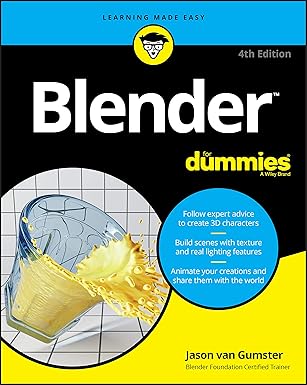
Discover a practical guide for mastering Blender with Blender For Dummies. This book offers an accessible approach to learning complex 3D modeling and animation techniques. It’s ideal for anyone interested in creating professional-quality 3D content without prior experience.
It’s ideal for anyone interested in creating professional-quality 3D content without prior experience.
Designed to simplify Blender’s extensive features, this guide breaks down concepts into clear, manageable steps. Readers can build confidence quickly while exploring essential tools and workflows. Its reader-friendly layout helps users avoid feeling overwhelmed by the software’s depth.
Its reader-friendly layout helps users avoid feeling overwhelmed by the software’s depth.
“Blender For Dummies” provides a comprehensive introduction to the software’s interface and core functions. It covers modeling, texturing, lighting, and rendering with practical examples.
The book emphasizes hands-on practice, allowing readers to apply skills effectively as they progress.
The content highlights features suited for beginners and intermediate users alike. Clear explanations and illustrations support learning, aiding retention of complex topics. Extensive tips focus on improving workflow efficiency, boosting productivity within Blender.
With thoughtful pacing and simple language, this guide is accessible to a wide audience. It suits students, hobbyists, and professionals seeking a solid foundation.
Its step-by-step instructions make 3D modeling approachable and enjoyable.
Pros
- Clear and easy-to-understand explanations for beginners
- Step-by-step instructions with practical examples
- Covers a broad range of Blender features and techniques
Cons
- May lack some advanced material for experienced users
This book offers valuable guidance for anyone starting with Blender. It balances depth and simplicity, making complex tasks more approachable and enjoyable. Suitable for casual learners and those preparing to explore more advanced 3D modeling software.
| Title | Blender For Dummies |
|---|---|
| Author | Jason van Gumster |
| Publisher | Wiley |
| Format | Paperback / eBook |
| Pages | 384 |
| ISBN | 1119616964 |
From my perspective, this guide is a solid choice for those entering the world of 3D modeling with Blender. It combines clear instructions with useful examples, helping readers build skills progressively.
The straightforward approach makes it easier to grasp Blender’s potential without overwhelming details.
Top Tips for Buying the Best Blender 3D Models
File format compatibility
When choosing 3D models, compatibility across different file formats is a key factor to keep in mind. Models that support common file types such as OBJ, FBX, and STL provide greater flexibility, making it easier to work within various 3D software environments.
Models designed with these standards can be quickly integrated into different projects, whether for animation, 3D printing, or game development. Paying attention to file format support helps streamline the creative workflow and minimizes technical hiccups during import, thus saving both time and effort while enhancing the overall user experience.
Creator reputation and support
When selecting 3D models, the background and reliability of the creator often provide valuable insights into the quality and dependability of the files offered. Observing reviews and ratings left by other users can help gauge how well the creator meets expectations and handles various challenges related to their models. Additionally, prompt and helpful customer support plays a key role in resolving any issues that might arise during the use of these models.
Continual updates and a transparent version history also suggest that the creator is actively maintaining their work, which means models are likely to be optimized for the latest software versions and incorporate user feedback for improvements over time.
Model quality and detail
When choosing the best blender 3d models, paying attention to resolution and polygon count can greatly impact both the appearance and performance in your projects. Higher polygon counts tend to offer smoother and more detailed shapes but may require more processing power, so balancing detail with your hardware capabilities is beneficial.
Texturing and material accuracy add depth and realism to models, with finely crafted textures helping to replicate surfaces convincingly, whether you’re aiming for shiny metals or rough wood. Deciding between a highly realistic look or a more stylized approach depends on the intended use; realistic models suit architectural visualizations or product renderings, while stylized ones often work well for animations or creative projects. Considering these factors together allows for making a well-informed choice suited to your specific creative needs and technical setup.
Purpose and use case
When choosing the best blender 3d models, it helps to focus on how they will be used, such as for animation, 3D printing, or VR/AR projects. Models intended for animation often require clean topology and rigging capabilities to facilitate smooth movement, while those designed for 3D printing should have watertight geometry and appropriate scale to ensure they print correctly without errors. VR and AR use cases benefit from models optimized for real-time rendering, which means they need to be lightweight but still maintain visual appeal.
VR and AR use cases benefit from models optimized for real-time rendering, which means they need to be lightweight but still maintain visual appeal. Customizability and modifiability are key features to look out for, as they allow you to adapt models to your specific project needs by adjusting details or textures. Additionally, picking models that fit the scale and size relevant to your work prevents issues in presentation or production, ensuring a cohesive and professional result.
Taking these factors into account can help you find models that not only look great but also function seamlessly within your intended workflow.
Licensing and usage rights
When choosing the best blender 3d models, understanding the licensing and usage rights is key to using them appropriately. Some models allow commercial as well as personal use, making them suitable for projects that require redistribution or inclusion in products for sale.
Others might restrict permissions solely to personal use, meaning the models cannot be used in any commercial endeavors. Restrictions on modifications and distribution can vary; certain licenses permit you to adapt the model and share your derivative works freely, while others may prohibit any alterations or require you to keep the original author credited if you distribute the files. Royalty-free options are often available, providing a flexible way to use 3d assets without ongoing fees or complex agreements.
Considering these factors helps select models that align with your intended use, whether for hobby projects, client work, or professional visualization tasks.
Price and value for money
When exploring different 3D models created with Blender, considering how their cost compares to similar options available can help determine the best fit for your project. Many platforms offer bundle or package deals that include multiple models or additional resources, providing more value and saving time searching for separate items. Free models often serve well for basic needs or experimentation, but premium models typically come with higher detail, better textures, and more customization possibilities, making them more suitable for professional use or complex scenes.
Free models often serve well for basic needs or experimentation, but premium models typically come with higher detail, better textures, and more customization possibilities, making them more suitable for professional use or complex scenes. Balancing the features you require against the overall investment ensures you choose models that offer both quality and practicality without overspending.
Frquently Asked Questions
What Are The Best Types Of Blender Models For Animation?
The best types of Blender models for animation are typically low to mid-poly models with clean topology and proper edge flow. These allow for smoother deformations during rigging and animation. Characters with well-designed armatures and facial rigs enhance expressive movements. Additionally, models with UV maps and texture baking support improve visual quality without heavy computational load. For complex animations, modular models or those with separate parts can simplify rigging. Ultimately, models optimized for the specific animation style—whether cartoonish or realistic—work best in Blender.
How Can I Find Free Blender Models For My Projects?
To find free Blender models for your projects, start by exploring popular websites like Blend Swap, Sketchfab, and TurboSquid, which offer a wide range of free downloadable models. Blender’s own community forums and Blender Market sometimes provide free assets too. Additionally, check out free 3D model repositories such as Free3D and CGTrader’s free section. Always verify the licensing terms to ensure they fit your project’s needs. Using search terms like “free Blender models” can also help you discover resources shared by artists on platforms like GitHub or social media.
What Are The Best Websites To Download High-Quality Blender Models?
Some of the best websites to download high-quality Blender models include Blend Swap, which offers a vast library of free, community-contributed models; TurboSquid, known for its professional-grade assets; and CGTrader, featuring both free and premium models with detailed previews. Sketchfab also provides a wide selection of 3D models, many optimized for Blender. Additionally, BlenderKit integrates directly into Blender, offering easy access to high-quality models within the software. These platforms cater to various needs, from beginners to advanced users, ensuring reliable, diverse options.
Which Blender Models Are Most Popular For Beginners?
For beginners, the most popular Blender models are simple objects like basic geometric shapes (cubes, spheres, and cylinders), low-poly characters, and everyday items such as chairs, tables, and bottles. These models are easy to create and modify, helping newcomers understand Blender’s interface and core tools. Additionally, beginner-friendly tutorials often focus on these types of models to teach essential skills like modeling, texturing, and lighting without overwhelming complexity. Starting with simple projects builds confidence before moving on to more advanced creations.
How Do I Import And Customize Blender Models Effectively?
To import and customize Blender models effectively, start by choosing the right file format (e.g., .blend, .obj, .fbx) compatible with your project. Import the model via File > Import and select the format. Once imported, switch to Edit Mode to modify geometry or Sculpt Mode for detailed shaping. Use the Material and Texture panels to customize colors and surface details. Utilize modifiers for non-destructive changes, and organize your model with collections for easier management. Finally, save your work regularly and use layering and naming conventions to streamline complex projects.
Conclusion
Choosing from the best blender 3d models means balancing quality, versatility, and ease of use. High-quality models offer detailed textures and realistic designs, ideal for professionals and hobbyists seeking precision. However, some models may require a learning curve or additional customization to fit specific projects.
However, some models may require a learning curve or additional customization to fit specific projects. For those working in animation, game design, or visualization, selecting models that align with project needs will save time and enhance creativity. While free options exist, premium models often provide better detail and support, which can be crucial for complex tasks.
Ultimately, the best blender 3d models cater to a wide range of users by combining functionality and aesthetic appeal. Careful evaluation of features against personal goals will lead to a satisfying and productive experience with Blender.